
Mental Health Act - named persons: guide
A guide to named persons in the Mental Health Act.
This document is also available in pdf format (202k)
In March 2003 the Scottish Parliament passed a new law, the Mental Health (Care and Treatment)(Scotland) Act 2003 It will come into effect in October 2005. It sets out how you can be treated if you have a mental illness including dementia, a learning disability or a personality disorder, and what your rights are.
This guide is one of a series about the new Act, and it explains how you can appoint someone to look after your interests if there is an application being made, a certificate has been issued or an order has been made, for you to be treated under the Act.
If you have to be treated under the new Act, the Act says that you can have a named person who will have to be informed and consulted about aspects of your care, and who can make certain applications under the Act.
The Act says
- when you can be given treatment against your will
- when you can be taken into hospital against your will
- what your rights are, and
- what safeguards there are to make sure your rights are protected.
This Guide is primarily written for people who use mental health services, but it may be of interest to others including carers or someone who might be asked to witness the documents for nominating a named person.
Disclaimer
While we have done our best to see that the information contained in this guide was accurate and up to date when it was published we cannot guarantee this. If you have any questions about how the information might apply to you, you should discuss your concerns with a solicitor, your independent advocate or other appropriate adviser.
Contents
1 Some terms used in this booklet
2 What is a named person?
3 Who can choose a named person?
4 What does a named person do?
5 What's the difference between a named person and an independent advocate?
6 When can I choose a named person?
7 Who can I choose to be a named person?
8 Who can help me decide who I should choose as my named person?
9 What if English is not my first language?
10 How do I nominate my named person?
11 What if I do not choose a named person?
12 What if I want to stop someone being my named person? (Making a Declaration)
13 What if I want to change my named person? (Revoking my nomination)
14 What if I change my mind about my declaration?
15 What if I want to change a named person I did not nominate?
16 Can anyone else change my named person?
17 Who can act as a witness for me?
18 Who should I tell that I have a nominated person?
19 How much will it cost to have a named person?
20 Contacts
21 Acknowledgements
Plus:
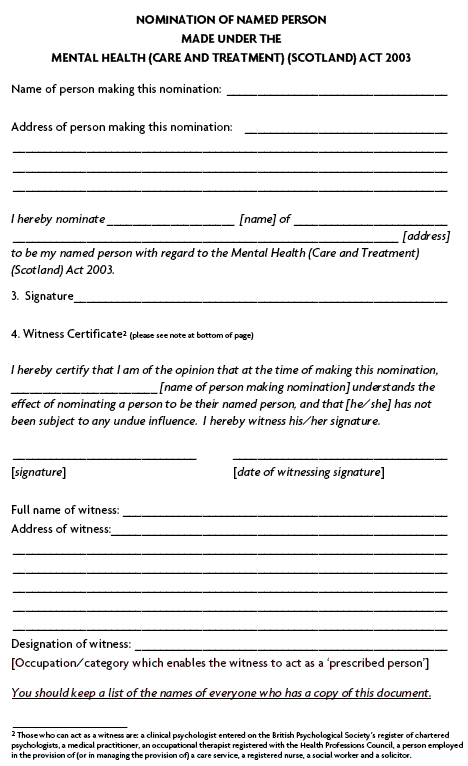
Suggested style for Nomination of named person
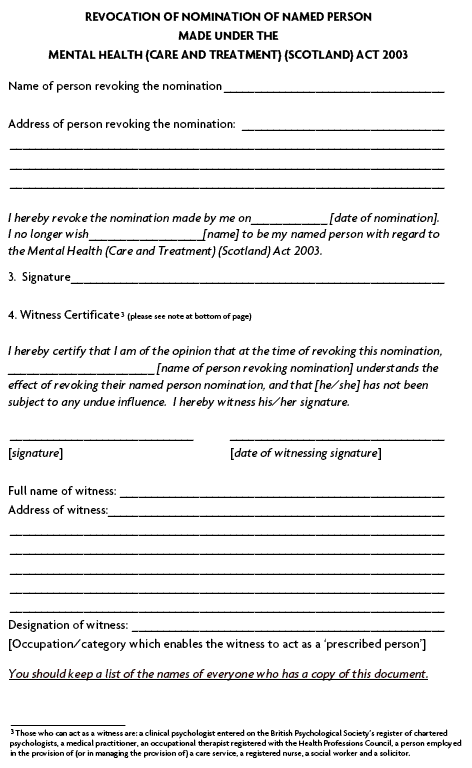
Suggested style for Revocation of nomination of named person
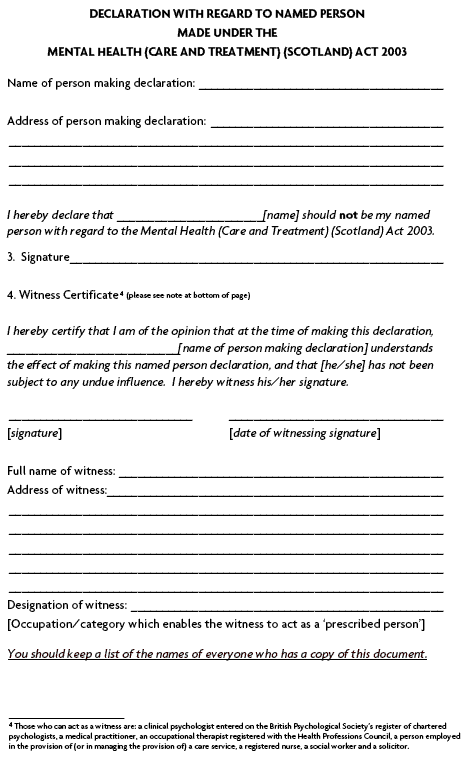
Suggested style for Declaration with regard to named person
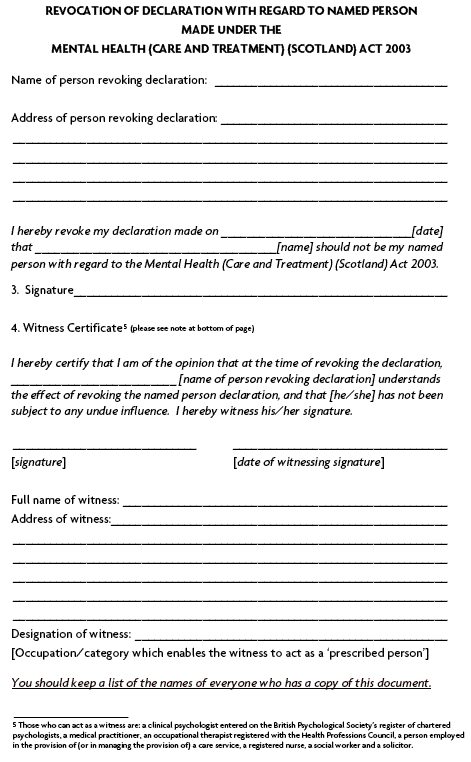
Suggested style for Revocation of declaration with regard to named person
1. Some terms used in this booklet
The Act - The Mental Health (Care and Treatment)(Scotland) Act 2003.
Advance statement - This is a written statement, drawn up and signed when the person is well, which sets out how s/he would prefer to be treated (or not treated) if s/he were to become ill in the future. It must be witnessed and dated. The Tribunal and any medical practitioner treating the person must have regard to an advance statement. If the wishes set out in an advance statement have not been followed the medical practitioner must send to the Mental Welfare Commission (and others) a written record giving the reasons.
CPN - Community Psychiatric Nurse.
Independent advocate - Under the Act anyone with a mental disorder has the right to access to independent advocacy services . An independent advocate is able to give support and help to enable a person to express their own views about their care and treatment.
Mental disorder - This is a term used in the Act to include people who have a mental illness including dementia, learning disability or personality disorder.
Mental Welfare Commission for Scotland - The Mental Welfare Commission for Scotland is an independent organisation. Its role is to protect the welfare of people who are vulnerable through mental disorder.
MHO - Mental Health Officer; a social worker who deals specially with people with mental disorder. Mental Health Officers have particular duties under the Act.
Named person - This is someone who will look after the person's interests if he or she has to be treated under the Act.
RMO - Responsible Medical Officer; the medical practitioner, usually a consultant psychiatrist, who is responsible for the person's care and treatment.
Tribunal - The Mental Health Tribunal for Scotland was set up by the Act to make decisions about the care and treatment of people with mental disorder.
2. What is a named person?
A named person can help to protect your interests if you have to be given care or treatment under the new Act. Under the new Act, you can have a named person who will have to be informed and consulted about aspects of your care, and who can make certain applications.
3. Who can choose a named person?
Anyone aged 16 or over can choose their own named person so long as the witness can certify that they understand the effect of choosing a named person and that they have not been under any undue influence.
If you are under 16 you cannot choose your named person. The Act says that your named person will be either
- a person who has parental rights and responsibilities for you, as long as they are 16 years old or more
- the local authority, if you are being looked after under a care order under the Children Act 1989, or
- in all other cases your main carer, as long as they are 16 years old or more.
In this situation, your named person will have all the same rights to information, to be consulted and to make applications as they would if you had chosen the person yourself.
See Note 11 below about what happens if you do not choose a named person.
4. What does a named person do?
If you have to be treated under the Act any person involved in your care must take account of the views of your named person, unless it is unreasonable or not practicable to do so. They must also take account of your own past and present wishes, and the views of your carer, guardian and welfare attorney if you have them.
Although you can nominate someone as your named person at any time after October 2004, your named person will only have rights if:
- there is an application being made, or
- a certificate has been issued, or
- an order has been made,
for you to be treated under the Act.
If you are being treated as a voluntary patient and there is no application pending for you to be treated under the Act, then your named person has no rights or powers.
It is important that you and your named person know that you can both act independently of each other. For example your named person can decide whether to make an application to a Tribunal on your behalf without waiting for you to ask them to do so. It might be that sometimes you and your named person might not agree on what action to take, and you are both entitled to act as you think fit. When you nominate someone as your named person you will want to choose someone who knows you well and whom you trust to act in your best interests.
A named person has a number of rights which appear throughout the Act. There are six different kinds of rights, and an example of each kind is listed below.
The named person has the right:
- to be consulted when certain things happen - such as when a short-term detention or an application for a compulsory treatment order ( CTO) is being considered;
- to be notified when certain changes to your circumstances happen - for example if your short-term detention is revoked;
- to receive copies of certain records or information which are given to you, including the record made if treatment has been given which conflicts with your advance statement (if you have made one). There is a separate guide in this series about Advance Statements;
- to make applications or appeals to the Mental Health Tribunal for Scotland (the Tribunal), and to speak and give or lead evidence at a hearing;
- to consent to two medical examinations taking place at the same time, if you are not capable of giving your consent to this (where two medical examinations are needed when an application has been made for a compulsory treatment order);
- to ask for an assessment of your needs from the local authority and/or Health Board.
5. What's the difference between a named person and an independent advocate?
Under the Act anyone with a mental disorder has the right to access independent advocacy services, whether or not the person is receiving compulsory treatment. An independent advocate is able to give support and help you to express your own views about your care and treatment. But an independent advocate cannot make decisions on your behalf in the way that your named person can. An independent advocate can come with you to a Tribunal hearing to support you but does not have the same rights as a named person to be consulted, informed or to make applications and representations to the Tribunal.
You can have both an independent advocate and a named person if you find it helpful, but because their roles are different they cannot be the same person.
6. When can I choose a named person?
You can choose someone to be your named person, or make a declaration about who you do not want to be your named person, any time from October 2004 onwards. However the nomination or declaration will not have effect until the Act is brought into effect in October 2005. You can choose a named person at any time after October 2004 providing your witness is able to confirm that you understand the effect of making a nomination, and that you haven't been put under pressure by anyone to make the nomination.
7. Who can I choose to be my named person?
Anyone can be your named person if he or she
- is aged 16 or over
- knows what is involved and has agreed to act as your named person, and
- the nomination has been signed and witnessed properly.
It can be your carer, spouse, nearest relative, another mental health service user or anyone else you would like to choose and who agrees to act, so long as that person continues to be capable of taking on this role.
Your named person should not be someone who has any responsibility for providing your care, for example your GP, responsible medical officer, mental health officer or community psychiatric nurse. This is because your named person must be able to make decisions independently about what he or she thinks is in your best interest, and this might be in conflict with what your care team think. You should be sure that you are happy that your named person will be able to make important decisions about your care and treatment if you are not able to do so for yourself. You should also bear in mind when you are choosing your named person that they might have this role for some time, and so it is important that you think carefully about who you would like to ask.
8. Who can help me decide who I should choose as my named person?
Choosing your named person is an important decision. You might want to discuss your choice with your family and friends, doctors or nurses who have been caring for you, your independent advocate or a solicitor if you have one. However it is important that you don't feel under pressure to choose someone. This is a decision for you to make, and you must be happy with whomever you choose. The witness who signs your nomination will have to confirm that you have made your decision freely without being put under pressure by anyone.
9. What if English is not my first language?
It is important that the information in your nomination, revocation or declaration documents can be clearly understood by the people who are responsible for your care. Your witness will also wish to be sure that you understand the importance of the decision you are making about your future care, and might want to ask you some questions.
If you wish to write your nomination, revocation or declaration in a language other than English you should seek interpretation and translation assistance from your Health Board and/or your local authority. Under the Race Relations (Amendment) Act 2000 they have a duty to provide support for this.
10. How do I nominate my named person? (Making a Nomination)
Once your chosen person has agreed to be your named person your nomination must be made in writing; it must be signed by you, and signed and dated by a witness, so long as the witness can certify that they understand the effect of choosing a named person and that they have not been under any undue influence. There is a suggested style at the back of this guide that you can use, but your nomination can be written on plain paper instead, using the same wording. It does not have to be typed, but it must be easily readable.
You can make a nomination at any time so long as your witness is able to confirm that you understand the effect of making a nomination, and that you haven't been put under pressure by anyone. Your nomination will stay in effect even if you later become unable to make decisions or communicate, either because of your mental disorder or because you have a physical disability.
11. What if I do not choose a named person?
If you are under 16 your named person will automatically be either your parent or guardian, the local authority or your main carer.
If you are 16 or over and you decide not to choose a named person, or the person you choose is not willing to do it, the Act says that your main adult carer will automatically be your named person. If you have more than one adult carer they can decide between them who it will be. If you have no adult carer who is willing to be your named person, then it will be your nearest relative. The Act contains a list to use to determine who your nearest relative is.
If there are no carers or relatives who are willing or able to be your named person, your mental health officer can apply to the Tribunal to have someone appointed as your named person. Anyone else who has an interest in your welfare can apply to the Tribunal asking them to appoint someone to be your named person.
12. What if I want to stop someone being appointed as my named person? (Making a Declaration)
If you are under 16 your named person will automatically be either your parent or guardian, the local authority or your main carer.
If you are 16 or over and you do not want a particular person to be your named person you can make a 'declaration' to stop them being chosen. However if this means that you would not have a named person at all your mental health officer might, in certain circumstances, have a duty to apply to the Tribunal to have someone appointed. The Tribunal will take your wishes into account but it has the power to make any order it thinks fit.
There is a suggested style at the back of this guide that you can use, but your declaration can be written on plain paper instead, using the same wording. It does not have to be typed, but it must be easily readable. You can make a declaration at any time so long as your witness is able to confirm that you understand the effect of making it, and that you haven't been put under pressure by anyone. Your declaration will stay in effect even if you later become unable to make decisions or communicate, either because of your mental disorder or because you have a physical disability.
13. What if I want to change my named person? (Revoking my nomination)
If you change your mind about your named person, for instance if your named person has moved away or you want to appoint someone more suitable, you can revoke your nomination.
There is a suggested style at the back of this guide that you can use, but your revocation can be written on plain paper instead, using the same wording. It does not have to be typed, but it must be easily readable. You can make a revocation at any time so long as your witness is able to confirm that you understand the effect of making it, and that you haven't been put under pressure by anyone.
If the person can no longer act for you, you should revoke their nomination and consider nominating someone else. In the meantime your primary carer or nearest relative will automatically be your named person.
14. What if I change my mind about my declaration?
You can revoke a declaration that names someone you don't want to be your named person. There is a suggested style at the back of this guide that you can use, but your revocation can be written on plain paper instead, using the same wording. It does not have to be typed, but it must be easily readable. You can make a revocation at any time so long as your witness is able to confirm that you understand the effect of making it, and that you haven't been put under pressure by anyone.
Revoking your declaration does not have the same effect as nominating a named person. If you want to choose a named person you will have to make a nomination.
15. What if I want to change a named person that I did not nominate?
If a named person has been appointed for you by a Tribuna you can apply to the Tribunal to have that person changed. You can apply to the Tribunal by writing them a letter explaining that you want to make an application under section 256 of the Act. You can telephone the Tribunal service for advice about what information to include in the letter. The Tribunal can also change your named person if he or she is thought to be inappropriate to act. This might be, for instance, always doing the opposite of what you say you want, or bullying you. The Tribunal will take account of your wishes, but it has the power to make whatever decisions it thinks fit.
16. Can anyone else change my named person?
There are a number of people who can apply to the Tribunal to have your named person changed, if he or she is thought to be inappropriate to act in the role. These people include your mental health officer, who in some circumstances has a duty to make an application to the Tribunal, as well as:
- your RMO
- if you are in hospital, the managers of the hospital
- your welfare attorney, if you have one
- your guardian, if you have one
- your relatives
- anyone else who has an interest in your welfare
The Tribunal can make whatever decision it thinks is in your best interest.
If you are under 16 an application to remove or replace a named person can also be made by someone who has parental responsibilities for you.
17. Who can act as a witness for me?
The person who acts as your witness must confirm that in his or her opinion you understand the effect of the decision you are making, and that you have made your decision freely, without undue pressure from anyone else. The witness must be someone who is either:
- clinical psychologists entered on the British Psychological Society's register of chartered psychologists;
- medical practitioners;
- occupational therapists registered with the Health Professions Council;
- persons working in, or managing , a care service 1;
- registered nurses;
- social workers; and
- solicitors.
1 Only staff working in, or managing, certain care services can act as a witness. This includes services like care homes, but does not include other services, like employment or training services. If there is any doubt about this, then staff should check before acting as a witness.
It would be a conflict of interest for the person named in any of the documents to also witness them. However, they could help you find another suitable witness instead. And you cannot witness your own documents, even if you are also qualified as a witness.
18. Who should I tell that I have a named person?
Anyone who is responsible for your care and treatment will need to know if you choose or change your named person. You should tell your
- responsible medical officer
- general practitioner
- mental health officer
- community psychiatric nurse
- solicitor
- independent advocate
(if you have them) and any other person close to you. Your named person might be able to help you do this. You might also want to make sure your carers and relatives know as well. You should keep a list of the names and contact details of the people who have been told who your named person is. If you decide to make any changes you will also need to make sure that everyone who is involved in your care knows about them.
19. How much will it cost to have a named person?
Before you ask anyone to help you nominate your named person, or to act as a witness, you should ask them if it will cost you anything. Some people you ask for help might need to charge you for their working time. If you ask a solicitor you should ask them whether legal aid will pay for some or all of the cost. If you are asked to pay more than you can afford you can ask the person to suggest someone else who can help you.
20. Contacts
Advocacy Safeguards Agency
1-2 St Andrew Square, EDINBURGH, EH2 2BD
Telephone:
Website: www.advocacysafeguards.org
Depression Alliance Scotland
3 Grosvenor Gardens, EDINBURGH, EH12 5JU
Telephone: 0131 467 7701
Website: www.depressionalliance.org
Mental Health Tribunal for Scotland
1 st Floor, Bothwell House, Hamilton Business Park, Caird Park, Hamilton, ML3 0QA
Website: www.mhtscot.org
Mental Welfare Commission for Scotland
Floor K, Argyle House, 3 Lady Lawson Street, Edinburgh EH3 9SH
Telephone: 0131 222 6111
FREEPHONE: 0800389 6809
Website: www.mwcscot.org.uk
National Schizophrenia Fellowship (Scotland)
Claremont House' 130 East Claremont Street, EDINBURGH EH7 4LB
Telephone: 0131 557 8969
Website: www.nsfscot.org.uk
Scottish Association for Mental Health ( SAMH)
Cumbrae House, 15 Carlton Court, Glasgow G5 9JP
Telephone : 0141 568 7000
Website: www.samh.org.uk
Scottish Consortium for Learning Disability ( SCLD)
The Adelphi Centre, Room 16, 12 Commercial Road, Glasgow, G5 0PQ
Telephone: 0141 418 5420
Website: www.scld.org.uk
Scottish Independent Advocacy Alliance ( SIAA)
138 Slateford Road, Edinburgh EH14 1LR
Telephone: 0131 445 8183
Website : www.siaa.org.uk
21. Acknowledgments
This guide was produced in collaboration with Scottish Association for Mental Health, National Schizophrenia Fellowship Scotland, the Advocacy Safeguards Agency, the Scottish Independent Advocacy Alliance, the Mental Welfare Commission for Scotland, the State Hospital at Carstairs, and the Scottish Executive.
We wish to thank Yvonne Osman for her assistance with this Guide. We also wish to thank all the mental health service users and carers who contributed their views on earlier drafts, and Joyce Mouriki and Chris Evans for facilitating this feedback.
.
.
.
There is a problem
Thanks for your feedback